
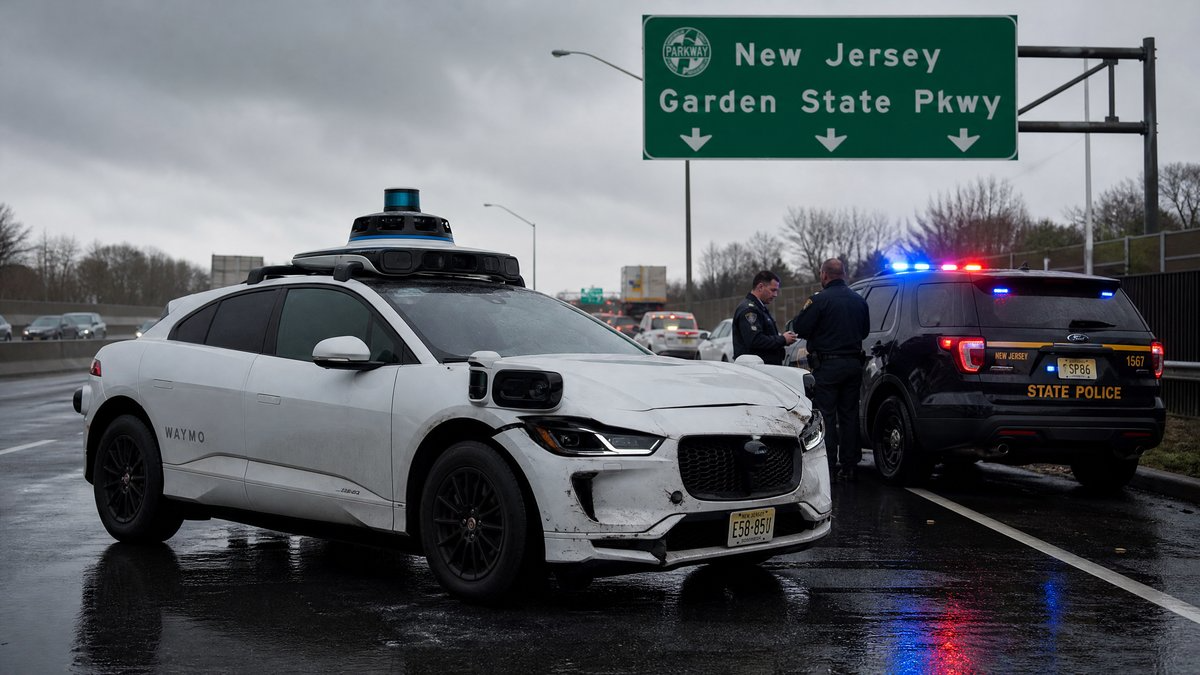
Self-driving technology is no longer science fiction on New Jersey roads. Teslas running Autopilot and Full Self-Driving travel the Turnpike and Garden State Parkway every day, and vehicles with advanced driver-assistance systems — automatic braking, lane centering, adaptive cruise control — are now the norm rather than the exception. But when one of these vehicles causes a crash, victims face a question that traditional car accident law never had to answer: who is responsible when the “driver” is partly a computer?
At Sarofiem & Antoun, LLC, our New Jersey car accident attorneys have watched this area of law evolve, and we can tell you the honest answer up front: liability in a self-driving car accident is rarely simple, and it often involves more than one responsible party. That complexity can work in your favor — additional liable parties can mean additional sources of compensation — but only if your claim is investigated and built correctly from the start.
This guide explains how New Jersey law applies to autonomous vehicle accidents, who can be held liable, what evidence matters most, and what you should do if you or a loved one has been injured.
Are Self-Driving Cars Actually "Driverless" in New Jersey?
Almost never. This is the single most important fact in these cases.
The Society of Automotive Engineers (SAE) classifies vehicle automation on a scale from Level 0 to Level 5:
- Level 0–2 (Driver Support): The human driver must remain fully engaged at all times. This includes Tesla Autopilot and Full Self-Driving (Beta/Supervised), GM Super Cruise, Ford BlueCruise, and virtually every consumer vehicle sold in New Jersey today. Despite marketing names that suggest otherwise, these are legally driver-assistance systems — not autonomous vehicles.
- Level 3 (Conditional Automation): The system drives under limited conditions, but the human must take over when prompted.
- Level 4–5 (High/Full Automation): The vehicle drives itself within defined conditions (Level 4) or anywhere (Level 5). Commercial robotaxi services operate at Level 4 in a handful of U.S. cities.
Why does this matter for your case? Because at Level 2 — which covers nearly every “self-driving” car on New Jersey roads — the human behind the wheel remains legally responsible for the vehicle’s operation. A driver who was watching a movie while Autopilot steered into your lane cannot hide behind the technology. Under New Jersey negligence law, they had a duty to supervise the system and intervene, and their failure to do so is negligence — full stop.
Tesla Autopilot and Full Self-Driving Accidents in New Jersey
Tesla vehicles deserve their own discussion, because they are involved in more “self-driving” accident questions than any other brand on New Jersey roads.
Despite the names, Tesla Autopilot and Full Self-Driving (Supervised) are Level 2 driver-assistance systems. Tesla’s own owner documentation requires the driver to keep their hands on the wheel and remain ready to take over at all times. In the eyes of New Jersey law, a Tesla operating on Autopilot has a fully responsible human driver — no different from a driver using cruise control.
That legal reality cuts in two directions for accident victims:
Against the driver: A Tesla driver who was texting, sleeping, or otherwise disengaged while Autopilot was active breached their duty of care. Evidence that the system issued takeover warnings the driver ignored can be powerful proof of negligence — and Tesla vehicles record exactly that kind of data.
Against Tesla: Federal safety regulators have scrutinized Autopilot’s design and driver-monitoring safeguards for years, including a recall involving roughly two million vehicles aimed at strengthening driver-engagement controls when Autosteer is active. Where a crash involves a system that failed to detect an obstacle, allowed misuse, or performed unpredictably, a product liability claim against Tesla may run alongside the negligence claim against the driver. Marketing that leads drivers to overestimate the system’s capabilities can also become part of a failure-to-warn theory.
Tesla crashes also generate uniquely rich evidence: onboard cameras, detailed system logs, and over-the-air software records that show precisely what the vehicle detected and when. Preserving that data quickly — before the vehicle is repaired, sold, or its data overwritten — is one of the first steps our firm takes in any Tesla Autopilot accident case.
If you were hit by a Tesla anywhere in Hudson County or the surrounding areas and you suspect Autopilot or Full Self-Driving was engaged, tell the responding officer, note anything the driver said about the system, and contact our office before speaking to any insurer.
Who Can Be Held Liable in a New Jersey Self-Driving Car Accident?
Depending on how the crash happened and what the vehicle’s systems were doing at the moment of impact, one or more of the following parties may be liable:
1. The Human Driver or Operator
If the vehicle required human supervision and the driver failed to pay attention, ignored takeover warnings, was distracted, drowsy, or impaired, they can be held liable under standard New Jersey negligence principles — the same framework that governs any car accident claim.
2. The Vehicle Manufacturer
If a defect in the vehicle’s design, hardware, sensors, or manufacturing caused or contributed to the crash, the manufacturer may be liable under the New Jersey Product Liability Act (N.J.S.A. 2A:58C-1 et seq.). Product liability claims do not require proving the manufacturer was careless — only that the product was defective and the defect caused your injuries. This is a significant advantage for victims, and it is one reason these cases demand attorneys who understand both auto negligence and product liability law.
3. The Software or Technology Developer
Autonomous driving systems are often built by companies separate from the automaker. If the software misread a traffic signal, failed to detect a pedestrian, or made a dangerous maneuver, the developer of that system may share liability.
4. Component and Sensor Suppliers
Cameras, radar, lidar, and processing chips come from third-party suppliers. A failed sensor that caused the vehicle to “miss” your car may create liability for its maker.
5. Fleet Operators, Rideshare, and Robotaxi Companies
When an autonomous or semi-autonomous vehicle is operated commercially — by a rideshare platform, delivery fleet, or robotaxi service — the operating company may be liable for negligent deployment, maintenance, or supervision of its vehicles.
6. Maintenance Providers and Vehicle Owners
Autonomous systems depend on properly calibrated sensors and up-to-date software. An owner or repair shop that neglected required maintenance, skipped safety-critical software updates, or improperly repaired sensor arrays may bear responsibility.
How New Jersey's No-Fault Insurance System Applies
New Jersey is a no-fault state, and that framework applies to self-driving car accidents the same way it applies to any other crash.
Your PIP benefits come first. Under New Jersey law, your own Personal Injury Protection (PIP) coverage pays your initial medical bills after a crash, regardless of who — or what — caused it. You do not need to wait for engineers to determine whether Autopilot malfunctioned before your medical treatment is covered.
The verbal threshold may apply to your right to sue. If you selected the limitation-on-lawsuit option (the “verbal threshold”) on your auto policy under N.J.S.A. 39:6A-8, you can only sue for pain and suffering if your injuries meet one of the statute’s categories, such as displaced fractures, significant scarring or disfigurement, permanent injury, loss of a body part, loss of a fetus, or death.
Here is a critical nuance most victims — and many attorneys — miss: the verbal threshold applies to claims against drivers and owners of motor vehicles. A product liability claim against a manufacturer is not a suit against a driver, and the threshold analysis differs. In practical terms, the presence of a defective autonomous system may open compensation pathways that a standard car accident claim would not. This is exactly the kind of issue where experienced counsel changes outcomes.
Comparative Negligence: What If You Were Partly at Fault?
New Jersey follows modified comparative negligence (N.J.S.A. 2A:15-5.1). You can recover compensation as long as you were not more than 50% at fault, though your recovery is reduced by your percentage of fault.
Expect this to be a battleground in autonomous vehicle cases. Manufacturers and insurers will argue the human driver should have intervened; the driver will blame the technology; each defendant will point at the others — and all of them may try to shift blame onto you. Multiple defendants pointing fingers is precisely the scenario where an unrepresented victim gets squeezed.
The Evidence That Wins Self-Driving Car Accident Cases
Autonomous and semi-autonomous vehicles generate enormous amounts of data — and that data is the heart of your case:
- Event Data Recorder (EDR): Speed, braking, steering input, and acceleration in the seconds before impact.
- Autonomous system logs: Whether the system was engaged, what it detected, what warnings it issued, and whether it demanded driver takeover.
- Camera and sensor recordings: What the vehicle “saw” — or failed to see.
- Telematics and over-the-air records: Software versions, known defect updates, and manufacturer communications.
- Federal crash reporting: The National Highway Traffic Safety Administration (NHTSA) requires manufacturers to report crashes involving automated driving systems, creating a paper trail that skilled attorneys know how to obtain.
Here is the problem: most of this evidence sits in the hands of the manufacturer or vehicle owner, and it does not preserve itself. Data can be overwritten, vehicles can be repaired or scrapped, and software can be updated in ways that obscure what happened. One of the first things our firm does in these cases is send preservation-of-evidence (spoliation) letters compelling every party to retain this data. The sooner that happens after your crash, the stronger your case.
What to Do After a Self-Driving Car Accident in New Jersey
- Call 911 and get medical attention. Your health comes first, and prompt treatment also documents your injuries.
- Tell the police the vehicle was in self-driving or driver-assist mode if you know or suspect it. Get it in the crash report.
- Photograph everything — vehicle positions, damage, the roadway, visible dashboard displays, and any screens showing system status.
- Get witness information. Independent witnesses are invaluable when defendants start blaming each other.
- Do not give recorded statements to any insurance company — including the manufacturer’s representatives — before speaking with an attorney.
- Contact a lawyer quickly. In these cases, early evidence preservation is not a formality; it is often the difference between a provable claim and a denied one.
Deadlines: Don't Let the Clock Run Out
New Jersey’s statute of limitations for personal injury claims — including those arising from autonomous vehicle crashes — is generally two years from the date of the accident (N.J.S.A. 2A:14-2). Product liability claims against manufacturers follow the same two-year period.
Two shorter deadlines can also apply:
- If a public entity is involved — for example, a government-operated vehicle or a claim involving roadway infrastructure — the New Jersey Tort Claims Act requires a notice of claim within 90 days (N.J.S.A. 59:8-8).
- Your PIP benefits have their own notice and treatment requirements under your policy.
Given how much technical investigation these cases require, waiting even a few months can put critical evidence out of reach.
Why Choose Sarofiem & Antoun for a Self-Driving Car Accident Case?
Autonomous vehicle claims sit at the intersection of car accident law, product liability, and insurance law — and they demand a firm comfortable in all three. At Sarofiem & Antoun, LLC, we bring the same approach to these emerging cases that has earned us hundreds of five-star reviews from injured New Jersey clients:
- We investigate immediately, preserving vehicle data before it disappears.
- We identify every liable party, not just the obvious one — because more defendants often means more available insurance coverage for your recovery.
- We handle everything on a contingency fee basis under New Jersey Court Rule 1:21-7. You pay nothing unless we recover compensation for you.
- We serve clients in English, Spanish, and Arabic from our office in the heart of Jersey City.
If a self-driving or driver-assisted vehicle injured you or someone you love anywhere in New Jersey, call (201) 792-3333 for a free, no-obligation consultation, or visit us at 895 Bergen Avenue, Suite 306, Jersey City, NJ 07306.
Frequently Asked Questions
Who is liable if a Tesla on Autopilot hits me in New Jersey?
In most cases, the Tesla driver remains liable, because Autopilot and Full Self-Driving are Level 2 driver-assistance systems that legally require constant human supervision. However, if a system defect contributed to the crash, Tesla may also be liable under the New Jersey Product Liability Act. Many cases involve claims against both.
Can I sue the manufacturer of a self-driving car in New Jersey?
Yes. If a defect in the vehicle’s design, software, sensors, or manufacturing caused or contributed to your crash, you may bring a product liability claim against the manufacturer, the software developer, or a component supplier — in addition to any negligence claim against the driver.
Does New Jersey's no-fault insurance apply to self-driving car accidents?
Yes. Your own PIP coverage pays your initial medical bills regardless of fault, just as in any New Jersey crash. Questions about who ultimately pays for your full losses — including pain and suffering — depend on liability and, in some cases, the verbal threshold on your policy.
What is the verbal threshold, and does it apply to autonomous vehicle claims?
The verbal threshold (N.J.S.A. 39:6A-8) limits lawsuits for pain and suffering against drivers and owners unless your injuries meet specific statutory categories. Product liability claims against manufacturers are analyzed differently, which is one reason a defective self-driving system can change the compensation available in your case.
How long do I have to file a self-driving car accident lawsuit in NJ?
Generally two years from the date of the accident under N.J.S.A. 2A:14-2. If a public entity is involved, a notice of claim may be required within 90 days. Because these cases require early evidence preservation, you should speak with an attorney as soon as possible.
What if the self-driving car that hit me had no one inside?
Fully driverless (Level 4) vehicles are operated by companies, not individuals. Claims in that situation typically target the operating company, the vehicle manufacturer, and the technology developer. These are complex commercial defendants with aggressive legal teams — do not face them without representation.
What evidence do I need after an autonomous vehicle crash?
The most important evidence is the vehicle’s own data: event data recorder readings, autonomous system logs, camera footage, and software records. Because this evidence is controlled by other parties and can be lost, your attorney should send preservation letters immediately.
How much does it cost to hire a self-driving car accident lawyer?
Nothing up front. Sarofiem & Antoun handles all injury cases on a contingency fee basis under New Jersey Court Rule 1:21-7 — we are only paid if we recover compensation for you. Consultations are free.
Get AI-powered insights from this article
